Towards Better
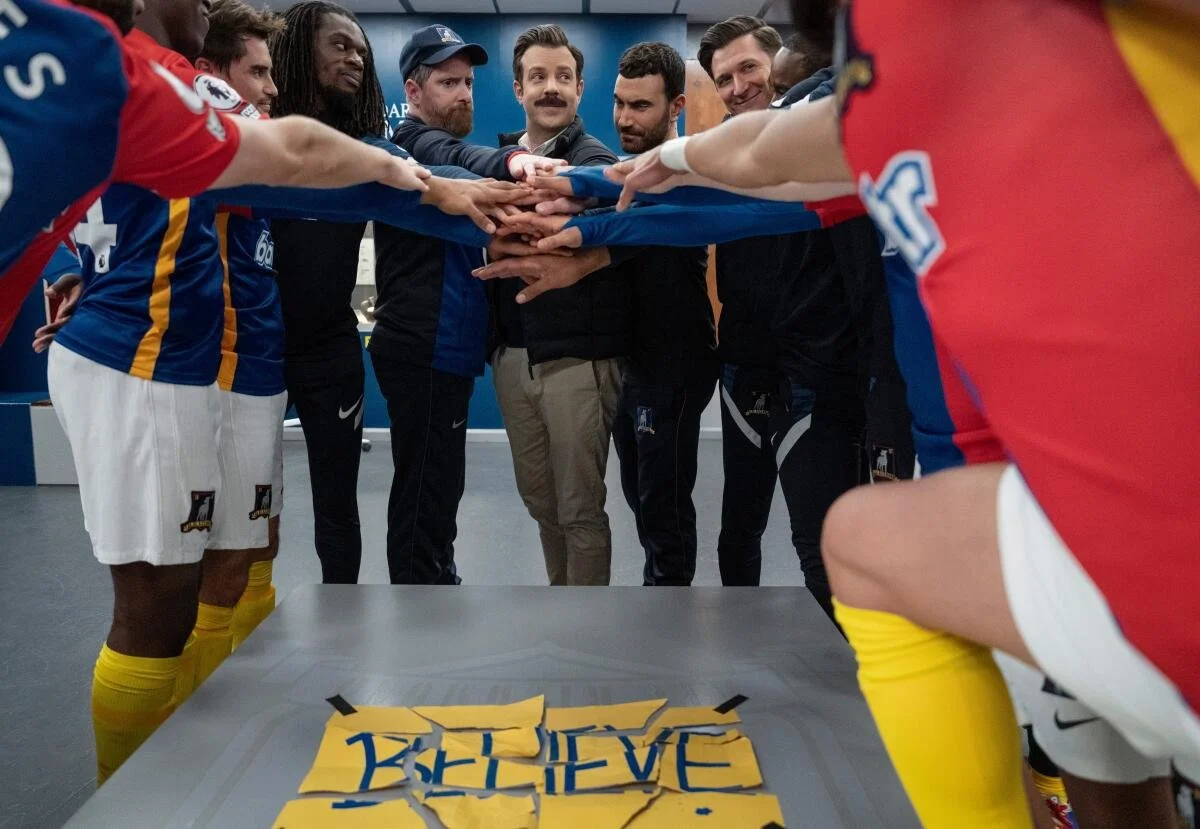
In our house, Ted Lasso has profound philosophical bordering on religious meaning. It is also comforting. There’s a metaphorical “in case of depression break glass” type alarm here where my mood starts to spiral and gets course corrected with a Ted Lasso rewatch.
There are so many things I love about that show. Most of these things have to do with theme and how it inspires, but I want to start with why I think the show works so well and why it is cleverly presented.
The show does something very clever right at the start. Ted Lasso has a premise that is far-fetched. Because it tests the viewers’ willing suspension of disbelief right from the get go, the show doesn’t have to worry too much about willing suspension of disbelief later. If you’re willing to put aside how unlikely it is that an American who knows next to nothing about European football is hired to be a Premier League manager, then you’re willing to accept things like: is it mathematically possible to go up and down the table to the degree that they do, Premier League teams don’t do mid-season club friendlies, or in the second season it would remove a lot of the tension in the last episode if you stop and think that if they don’t win that last match, they would still be in a playoff for promotion. None of that matters because the writers already allowed the viewer to put reality aside and enjoy the characters and all the wonderful themes.
That we are watching something unrealistic is fine. It also fits in well with the ongoing Wizard of Oz motif. After they’ve flown from Kansas, Ted says, “We’re not in Kansas anymore.” The pinball machine in the pub is a Wizard of Oz pinball machine. In the last episode Ted is wearing red shoes.Ted tells the team in season two that “[they] are in their black forest and that fairy tales do not begin and they do not end there.” There are numerous other Wizard of Oz movie and book references where the writers are telling us that we are in a story and they are using the power of those stories and references to convey a message.
The characters on Ted Lasso are wonderful. Even when they’re behaving badly it’s comforting to spend time with them. Besides Fringe, I don’t think there’s another example of an ensemble cast in a series where I like every character to such a degree that I’m quite happy watching it whichever character is the focus at any given moment.
When the characters on Ted Lasso are faced with their mistakes they strive to correct them. Accountability and improvement are main themes in the show. Originally when I started writing this, I wanted to focus entirely on characters and the cleverness of how the show is constructed, but the themes are such a part of that, they are so woven into the fabric of the show that it would be nigh impossible not to discuss them.
The main theme of Ted Lasso is striving to be a better person. Characters are often reading or seeking knowledge. Everyone of the characters has to face up to failures or mistakes and everyone of them learns not just how to deal with that problem but acquire tools for continuing to improve. Ted even says that he doesn’t care about the wins and losses, he’s there to help people improve “on and off the field.” My favorite scene for this, and maybe the culmination of the show even more than winning the last match, is Higgins’s speech in the last episode. “Human beings are never going to be perfect, Roy. The best we can do is to keep asking for help and accepting it when you can. And if you can keep on doing that, you'll always be moving towards better.”
I find all of the moments of this show, especially the lines about it’s more important to try even if you fail, not dwelling on mistakes and the past, and always moving towards better, to be immensely inspiring.