Favorite Fringe Episodes
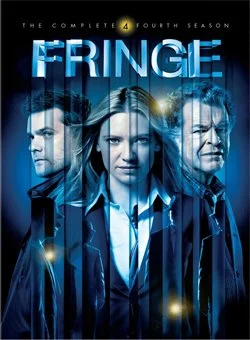
The television show Fringe was a significant inspiration for my Azure Cove science fiction series. In fact my sleazy Hollywood pitch for Azure Cove is “It’s Fringe meets Real Genius,” as each book’s plot is a weird science story, but I tried to keep it less dark and more positive than the very dystopian Fringe. My story centers entirely around academics as characters, they aren’t law enforcement. My series also has many more influences, but Fringe is a key one. Since I’m starting to write the third Azure Cove novel and trying to keep my spirits up during the first draft blues, I picked out some key episodes of the show to watch. Watching a few made me want to watch it all of course, but there’s only so much time available. This got me thinking about what my favorite episodes of this great work are. Normally such lists are in threes or fives, but I knew going in I’d require more than that. Deciding I couldn’t just list the entire series, I narrowed it down to eight episodes.
1.1 Pilot
I think Fringe and Twin Peaks have the best pilots of any television show. Often television pilots are still finding their feet. They might demonstrate the promise of the material, but there are things that need changing and the creators are still figuring out how to convey their story. Fringe and Twin Peaks knew what they were doing from the start. I already wrote about Twin Peaks in my most recent rewatch of that series. These are pilot episodes of a tv show, but they feel movie quality, from times when movies were significantly better regarded than television.
Fringe starts with a horrifying mystery. From there we meet an FBI agent who is desperate for a cure for her partner. It could have just been an X-Files clone from that point (some of the first two seasons filler episodes even seemed a lot like X-Files spec scripts converted to the Fringe world), but we meet Walter Bishop, a troubled mad scientist, one of my all time favorite characters and we get to the premise of the show.
If the premise of the X-Files is what if aliens were really visiting our world? The premise of Fringe is largely what if everything in Project MK Ultra was true?
They pull Bishop out of an insane asylum, and soon after that he’s saying “Excellent, let’s make some LSD,” and brewing up a batch. Right in the pilot the show is going to the hallucinatory and the bizarre and it works so well. From the start Fringe exercises the audience’s willing suspension of disbelief, it helps to strengthen our imaginations. Once fortified, it can tell its story.
1.10 Safe
I toyed with listing an earlier episode “In Which We Meet David Robert Jones,” but I didn’t want to open up this list, because I could easily write about why I think nearly every episode is great, and that would really get in the way of the novel I want to get a draft of before the end of the year.
David Robert Jones is a fantastic villain played by Jared Harris. Tangent: if you’re looking for good science fiction, just look at Jared Harris’s IMDB page: Foundation, The Expanse, Fringe… Hell, even Chernobyl in a way is science fiction, I mean it’s an historical event, but it is a fictional telling and they do use science to figure out how to resolve the problem.
“Safe” opens with a robbery gone wrong. The thieves are using weird science technology to move through solid objects and one of them gets stuck inside. Walter soon realizes that the thieves are stealing from safety deposit boxes he owned. The unreliability of memory and that Walter has weird tech stashed all over the northeastern seaboard are both running themes in Fringe.
The thieves are stealing this tech so that they can bust David Robert Jones out of prison in Germany by teleporting him from his cell to the United States!
1.20 There’s More Than One of Everything
As anyone who’s read the second Azure Cove novel, The Many Worlds Interpretation of Azure Cove knows, I love multiverse stories.
The Fringe setting is less of a true multiverse. It isn’t DC’s Crisis on Infinite Earths and we don’t see wacky Everything Everywhere All At Once worlds. We only see two for the most part, there are a few others, but generally everything is a version of these two. Much of the storyline for the series involves the interaction between those two universes and characters and the other versions of themselves. This isn’t the episode that first sets up their version of the multiverse, but it does a lot of the work of establishing the storyline that is so important to the background of the show.
In later episodes they’ll introduce a cross universe espionage story complete with a quantum entangled type writer that can send messages across universes!
2.18 White Tulip
This episode is brilliant and heartbreaking and yet also about hope. Peter Weller plays a physicist who has lost the woman he loved in an accident. He is utilizing time travel to try and get back to her.
Walter is rapt with guilt and his secret that his world’s version of Walter’s son died as a child and in an effort to help save the other world’s version of his son, he sort of kind of set off most of these terrible events by taking him from that universe.
Walter finds Peter Weller’s character and tells him that he’s looking for a sign of hope to give him the strength to tell his son his secret: a white tulip. After Peter Weller’s character makes it back to the time of the accident where it becomes clear he’s aware he can’t save her but he apologizes for the fight and dies with her, a confidant of his mails a letter to Walter Bishop. Walter, unaware of who Peter Weller’s character is since the timeline has been altered so that they never spoke, opens the envelope and pulls out a drawing of a white tulip.
2.2 Brown Betty
As is often the case, I find I like the stories that the fans of a series dislike the most.
This episode is silly and different, but also sort of heart wrenching. I can see why people didn’t care for it: people rarely want something to break form and challenge them, a lot of people also can’t take a story seriously if it’s funny (some people just want bleak all the time), and increasingly since the advent of streaming people want tightly plotted short seasons, which are great, but also miss out I think on the opportunity to be silly and have some fun with things.
3.19 Lysergic Acid Diethylamide
The episode in which they go inside Olivia’s mind because her body is currently housing Leonard Nimoy’s character’s consciousness and they need to find her to help save her. This episode has it all: hallucinogens, quirky thinking, a sequence were all the characters are converted to animation… I love it.
Tangent: There is a science mistake in this episode, and I wonder if it was a slip-up or if there was a studio note forcing them to say the incorrect thing. Walter says “we need two-thousand milligrams of LSD.” LSD is measured in micrograms. Two-thousand milligrams is two-million micrograms, or about twenty-thousand doses (if my very dodgy Google search is correct). My question is: did the writers make a mistake or did someone say something like “normal people won’t understand micrograms”?
5.9 Black Blotter
By season 5 the show has shifted to a timeline where time traveling scientists from the far future have taken over the world and established a fascist government. It is pretty bleak. But there are some great moments as the team fight back.
And I wanted to include this episode because it’s the one with the Monty Python style animation to convey Walter, who is on a lot of acid, trying to remember a key piece of information.
5.13 An Enemy of Fate
The bittersweet series conclusion beautifully ties it all up. The themes of loss, redemption, love and hope, are all part of the stitchwort that wraps the storyline.
All in all this was such a great show and along with Twin Peaks and Stranger Things these are stories that inspire me to get in front of the computer and write.