Stranger Things
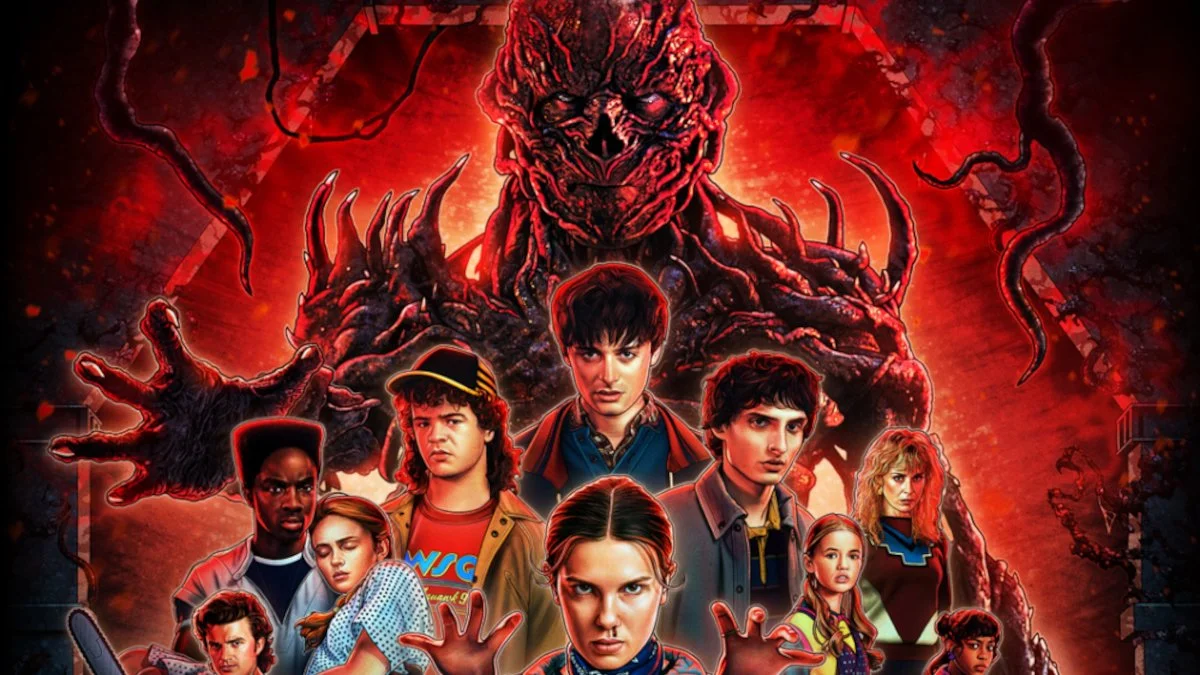
Stranger Things has ended and I can’t stop thinking about it. I kind of want to just watch it all again, but with my time not being infinite, I probably better give it some space before I start it once more. I am pretty certain this will be something I will return to regularly along the same lines that I return to Middle Earth or to Douglas Adams’s books.
Before I put it on the shelf for a while, I wanted to sort out my thoughts while they’re still fresh. If you’re reading this and haven’t seen the ending yet, if you don’t want any spoilers even mood wise, best to stop reading now.
Art can accomplish all sorts of things. It can inspire. It can be thought provoking. It can provide in escape from harsh reality. It connect with you emotionally. For me, Stranger Things managed to do all of these things.
Art can inspire. I really became interested in reading because my father read The Lord of the Rings to me, and I wanted to be able to experience the story even when he was at work. I first wanted to write because I watched Blake’s 7 when I was a teen, and the dialogue and brooding antiheroes were a perfect mix for me at that time.
Before watching season 5 of Stranger Things, we rewatched the first four seasons. Every single morning after we watched an episode, I found myself highly motivated to write. What I was working on wasn’t even in the same genre. It wasn’t even in our world, let alone a highly idealized version of the 1980s of our world, and yet I was so inspired that each morning it just clicked. Writing doesn’t always click like that for me. And the days when it’s not clicking can feel miserable. The days when it is, there are few better feelings.
For inspiration, as an adult, the most comparable thing I’ve found to Stranger Things is Fringe. It might seem like comparing apples and oranges. Fringe was network television and for most of it episodic. Stranger Things was streaming and in distinct story arcs. Fringe was more bleak and dystopian. Stranger Things was fairly hopeful. The cast of Fringe were adults, and Walter Bishop an older adult at that. Whereas of course the cast of Stranger Things were mostly kids, teens, and a few adults played by actors who were kids and teens when the show was set.
There are similarities though. They’re both science fiction shows where at times the science pushes the envelope even on the theoretical. Both shows value knowledge and research and the characters spend time acquiring data, establishing models to fit that data, and then correcting those models when the data shows that they were wrong. To me, a writer who is really more of a researcher who happens to write, this is incredibly encouraging to see. I’m also pleased to see it because I think it combats a pro ignorance segment of our society. Here they are deploying the scientific method, reading books, and even going to the library, and the show makes it compelling to watch.
Art can be thought provoking.
At the same age as the kids in season 1 of Stranger Things, I was already a full fledged nerd. At that point I didn’t think much about why I liked what I liked. When I look back at it now I realize that I preferred many of the things I did because those things were thought provoking. I’d been obsessed with astronomy after watching Cosmos on PBS (non-fiction, but still art) and that led to my room being largely plastered in JPL photos of the Jovian moons from the Voyager flybys.
The other thing that was on my bedroom wall was The World of Greyhawk map.
I had started playing Dungeons and Dragons with one group of friends who lived in my neighborhood. By junior high school (Long Beach didn’t switch to middle schools and four-year high schools until 1990), we were playing many more games, and I was playing with other groups of friends, often at school, on the bus, or at lunch. We played lot’s of D&D, Top Secret, Gamma World, and Star Frontiers (at that point we were apparently working our way through the TSR catalog). I always had a pad of graph paper for making dungeon maps. I usually had a rulebook for one or more games in my backpack at all times. And whenever I’d get the chance, even if we weren’t playing at the moment, I’d flip through those books, or stare at the maps, and imagine the things that would happen in them.
Many of the other books I read were just as helpful for cultivating the imagination. I was big into comics, and particularly the X-Men. But I don’t think my reason for preferring the X-Men was the typical teen boy “Wolverine’s a badass.” Looking back on it, I’m pretty sure I truly fell in love with comics because of the weirdness and the thought provoking run from the Chris Claremont days, a high I think I’ve been chasing ever since, and occasionally reached with the writings of Grant Morrison and a few others.
Stranger Things is also thought provoking. For one thing I think I’ve blogged about it more than any other subject. But also it has Mr. Clarke talking about Hugh Everett and the many worlds interpretation of quantum mechanics. It presents characters that are themselves exploring, discovering, and wondering about their weird science setting. Most of all I think it does a fine job of asking what if, realizing the answer is never one hundred percent correct, and rather than giving up, asking the question again and again.
It might seem paradoxical that stories set with such horrors in them can be comforting forms of escape. I often reread Lord of the Rings when things get bleak in the real world. When I was younger I probably read Douglas Adams’s Hitchhiker’s Guide to the Galaxy once a year, and that book starts with the Earth getting blown up.
These stories don’t just provide a necessary respite from reality, they have helped pick me back up again when I have to go back out into the real world once more. They help to process terror in a safe space so that we can deal with or at least endure the ones we face in our own lives.
Sam Gamgee says in the movie version of Two Towers, “It’s like in the great stories. Full of darkness and danger they were. … But in the end it’s only a passing thing, this shadow. Even darkness will pass. A new day will come. And when the sun shines it will shine out the clearer. Those were the stories that stayed with you, that meant something. Even if you were too small to understand why.” The full quote is great, but the point is that it’s often stories that help us find not just solace but also the determination to continue.
Stranger Things managed this. Hawkins in a very idealized dream of the 1980s gives us a place to escape to. The characters endure horrific trauma, but they come through. They are forever changed by their experience, but also emerge hopeful, better, and true to themselves.
Stranger Things connected with me emotionally. I was born in 1971. I’m the same year as Mike and his friends. I started playing D&D in the early 1980s. And they nailed the attention to detail for some of these things… there’s a scene in season 3 where Will has set up the D&D campaign and he’s used the TSR Marvel Superheroes folded characters for figurines because what kid could afford enough minis, and I shouted “I did that!”
But I don’t think it is merely nostalgia. The Stranger Things writers made characters that are easy to connect to. And not just the kids. Joyce Byers is a strong character. She’s seen initially as having a mental break, but she ends up being right, and right repeatedly through the series. The adults on the show are compelling, partially because we see them caring for the kids. My all time favorite side character, Mr. Clarke (super heroic middle school science teacher) is a great character. He’d always be there for his students. Even when they call or show up at his house at inappropriate hours when he’s on a date. And then he’s discussing theoretical physics concepts without any bullshit worries about whether or not this will take away from cramming from some crappy standardized test. Every character has something about them that is either admirable or at least relatable.
By the end of the finale each of the characters deals with their trauma and problems in some way and is prepared to move on.
The story was largely about the characters growing up. It’s about childlike wonder and learning to be an adult. But I think it also serves as a reminder that there’s a benefit to keeping some portion of that wonder kindled for when we need inspiration, to imagine, to learn, and we need to be passionate about the things that are important to us.